You've seen it happen. A hurricane barrels through, an ice storm takes down infrastructure, or a mass-casualty event floods a metro area with panic-dials. Within minutes, everyone reaches for their smartphone and nobody can get through. The network collapses under the weight of demand, or a cell towers goes dark.
But somewhere nearby, a first responder, a search-and-rescue volunteer, or a prepared community member is still communicating clearly and instantly. Chances are, they're using a PoC radio, and understanding how it works differently from your phone can be the difference between coordination and chaos.
|
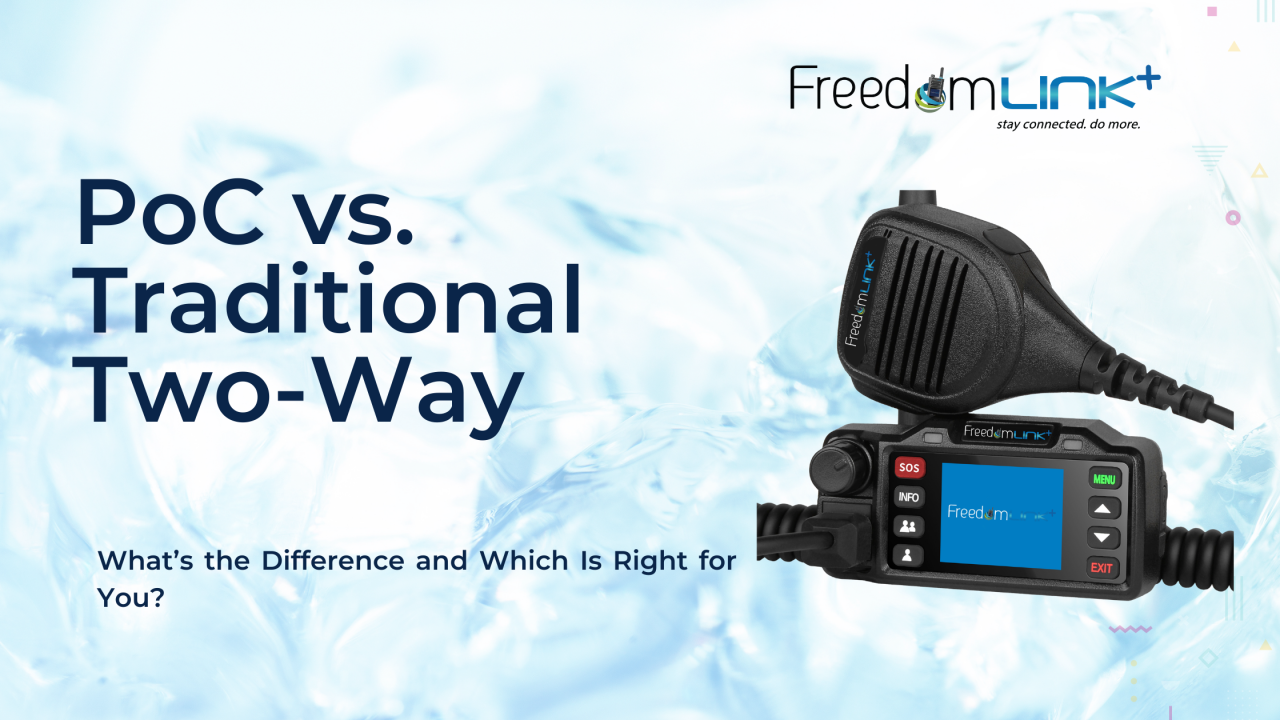
QUICK DEFINITION PoC stands for Push-to-Talk over Cellular. PoC radios look and operate like traditional two-way radios but route voice transmissions over cellular data networks (LTE/4G/5G) or Wi-Fi instead of dedicated radio frequencies. |
Why Cell Phones Fail in Emergencies
Your smartphone is a marvel of modern engineering, but it has a fundamental architectural weakness in emergencies: it shares the same network infrastructure as everyone else around you.
When a disaster strikes a region, everyone in that area simultaneously tries to contact loved ones, emergency services, and colleagues. Cell towers are engineered to handle average demand, not peak crisis demand. The system becomes saturated. Carrier networks implement congestion controls that throttle or block voice calls, SMS messages queue for hours, and data rates crawl to near-zero.
Physical damage compounds this. Tower power supplies fail when utility lines go down. Backup generators run out of fuel. Emergency responders may gain priority access through GETS/WPS protocols, but the average citizen is locked out.
|
NETWORK SATURATION Cell towers become overloaded when thousands of people make simultaneous calls during an emergency event. |
INFRASTRUCTURE DAMAGE Physical tower damage, power outages, and flooded equipment rooms knock towers offline entirely. |
PRIORITY BLOCKING Carriers may throttle civilian traffic to reserve capacity for emergency services during declared disasters. |
"PoC radios use the same towers as your phone, but they use them very differently."
How PoC Radios Actually Work
Here's the key insight most people miss: PoC radios do use cellular networks. They are not magic. But they use those networks in a fundamentally different way than voice calls on a smartphone, and that difference is what matters when the grid is stressed.
1. You press the PTT button
Your radio begins recording and compressing voice audio in real time using efficient codecs like AMBE+2 or Opus, the same codecs used in professional dispatch systems.
2. Audio is packetized as data
Unlike a traditional phone call that opens a dedicated circuit, PoC converts your voice into small data packets, just like a text message or an email, and fires them across the cellular data channel.
3. Data reaches a dispatch server
The packets travel to a centralized PoC dispatch server in the cloud or a private data center. The server routes the transmission to the correct talkgroup or individual channel.
4. Recipients receive the broadcast
All radios subscribed to that talkgroup receive the audio within 300 to 500 milliseconds. No ringing, no call setup time, no busy signals. One-to-many communication, instantly.
Because PoC traffic is treated as data rather than a voice call, it slips through network congestion that would block traditional calls. Data packets are smaller, use lower bandwidth, and can be prioritized differently by carriers. Many PoC solutions also support automatic roaming across all available carriers simultaneously, meaning if one network is congested, the radio switches to another without user intervention.
The Advantage in Crisis Conditions
Let's walk through a realistic scenario. A severe thunderstorm knocks out power across a county. Cell towers run on backup power, but local voice traffic has spiked 600% as residents attempt to reach family members. Traditional calls aren't connecting.
A community emergency response team using PoC radios can still communicate because their transmissions are data packets flowing through a different lane of the same infrastructure. The servers handling their dispatch traffic are in remote data centers unaffected by the local storm. Even if one carrier's data network in the area degrades, multi-carrier PoC devices can fall back to a neighboring carrier's LTE signal.
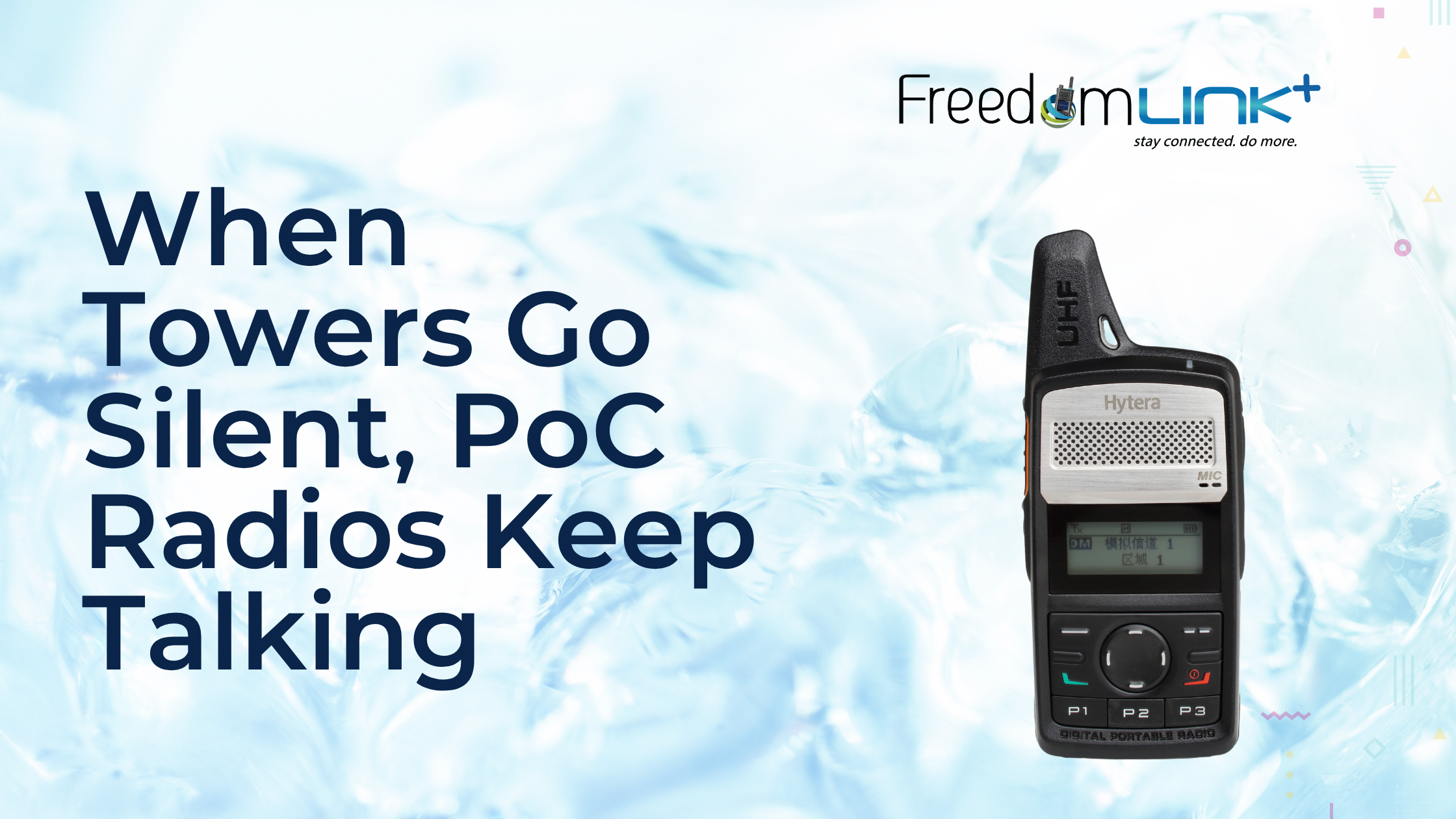
And when cellular coverage is truly gone? Many modern PoC radios are hybrid devices. They can switch to traditional VHF/UHF radio frequencies, Wi-Fi-based transmission over mesh networks, or satellite uplink, depending on model and configuration.
|
RANGE & COVERAGE Traditional handheld radios are limited by line-of-sight, typically 1 to 5 miles in real-world conditions. A PoC radio using cellular data has the same coverage footprint as your cellular provider: hundreds of miles, including across state and national boundaries. Your team can coordinate across the entire affected region, not just a neighborhood. |
PoC vs. Traditional Two-Way Radio
Traditional two-way radios that operate on FRS, GMRS, or licensed VHF/UHF frequencies remain a critical part of any preparedness toolkit. They require zero infrastructure and work when every other system is down. But they have real limitations: short range, limited to line-of-sight, often require repeater infrastructure for area-wide coverage, and are susceptible to frequency congestion when many users are on air simultaneously.
PoC radios complement traditional radios rather than replacing them. The smartest preparedness approach is a layered communication strategy: PoC when cellular data exists, traditional radio as a fallback, and satellite or mesh as a last resort.
To be clear, PoC is not an off-grid solution. If your priority is communication completely independent of any infrastructure — no towers, no internet, no power grid — a traditional radio or satellite device is the right tool. PoC shines in the far more common scenario where infrastructure exists but is stressed or congested.
What to Look For in a PoC Radio
|
MULTI-CARRIER SUPPORT Devices that roam across AT&T, Verizon, and T-Mobile, multi-carrier, simultaneously have the best chance of maintaining connectivity during local outages. |
WI-FI FALLBACK If cellular is unavailable but a local Wi-Fi or mesh network exists, the radio should seamlessly switch over without manual intervention. |
DISPATCH PLATFORM The backend server matters. Look for redundant cloud infrastructure hosted across multiple geographic regions with 99.9%+ uptime SLA. |
HYBRID CAPABILITY The best devices also include traditional radio modes (VHF/UHF) so communication continues when all digital infrastructure fails. |
For families, community groups, and small organizations, the subscription-based model of PoC services means no repeater infrastructure to maintain, no license exam required for standard use, and radios that work coast-to-coast on day one.
The Bottom Line
When cell phones go silent, it's usually not because the towers are gone. It's because every voice call pipeline is jammed. PoC radios sidestep that jam entirely by traveling as data, connecting through dispatch servers that sit outside the disaster zone, and roaming across carriers automatically.
They won't work in every scenario. Nothing will. But in the most common emergency communication failure, network saturation during a crisis, PoC radios are specifically engineered to keep working when standard smartphones can't. For any preparedness-minded individual, team, or organization, that's a capability worth understanding and having ready.
At FreedomLINK+, we're committed to helping our community understand not just the tools, but the principles behind resilient communication. Know your equipment. Know its limits. Know your fallback.
TOPICS
Emergency Communications | PoC Radios | Preparedness | Push-to-Talk | Cellular Networks | CERT | Disaster Response