freedom link + logo freedom link + logo
  • HOME
  • NATIONWIDE PUSH-TO-TALK
    • BENEFITS
    • DEVICES
      • FreedomLINK+
      • HYTERA
      • KIRISUN
      • ICOM
    • DISPATCH SOLUTIONS
    • Hytera BRIDGE - PoC System Interconnect Solution
    • CELLULAR PUSH-TO-TALK APP
    • ACCESSORIES
      • FreedomLINK+
      • HYTERA
      • KIRISUN
      • ICOM
      • MAGNETIC MIC
    • Why FreedomLINK+
  • INDUSTRIES
    • AGRICULTURE
    • CHURCHES AND RELIGIOUS ORGINIZATIONS
    • CONSTRUCTION
    • EDUCATION
    • EVENTS
    • HAZARDOUS ENVIRONMENTS UL913
    • HEALTHCARE
    • HOSPITALITY
    • MANUFACTURING
    • MINING AND UTILITIES
    • MUNICIPALITIES AND GOVERNMENT
    • RETAIL
    • TRANSPORTATION AND LOGISTICS
    • SECURITY
  • ABOUT US
    • FAQ
    • BLOG
    • Customer Stories
  • IoT
    • Peplink Modems
    • SIM Card
  • CONTACT
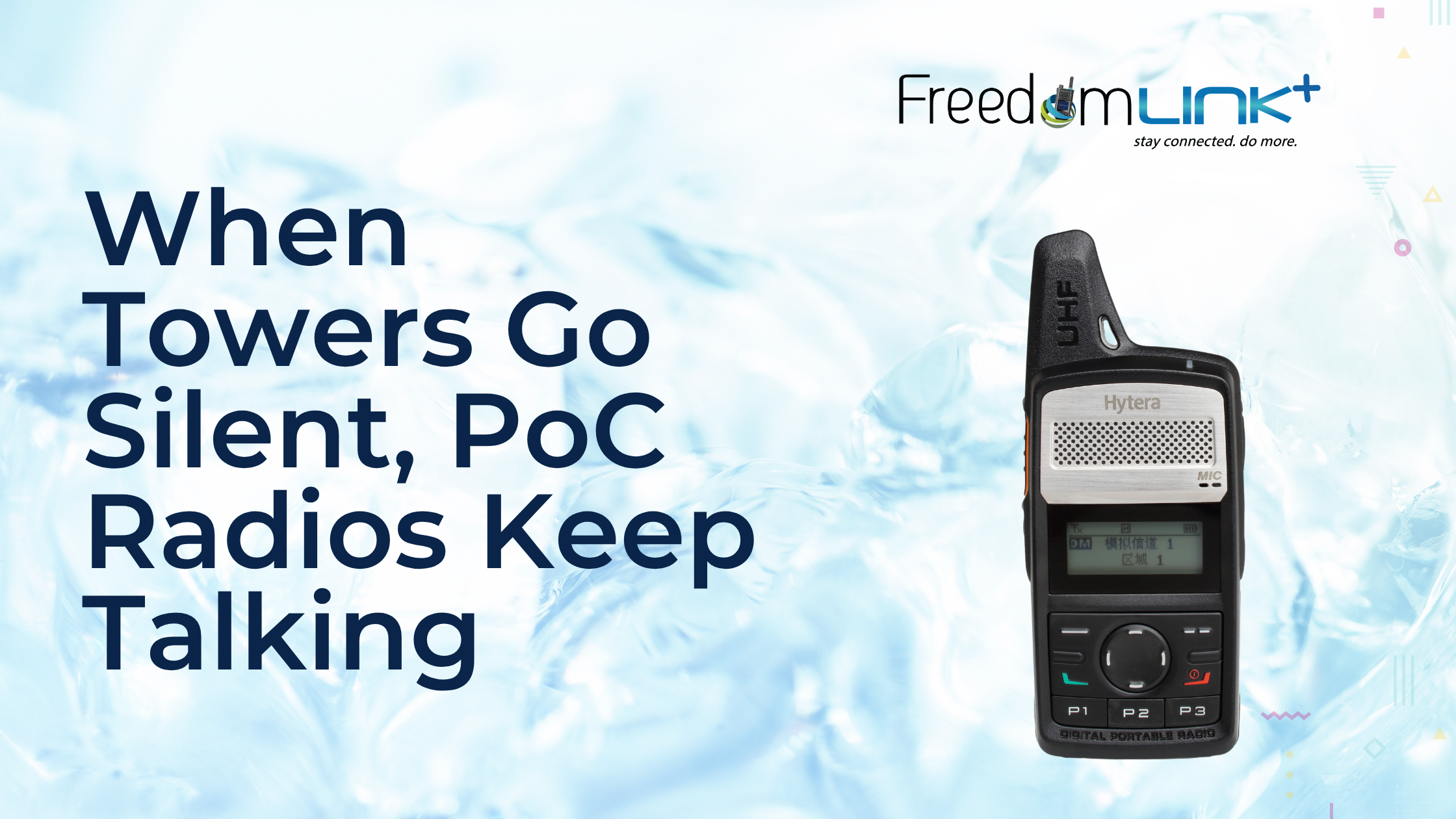
When Towers Go Silent, PoC Radios Keep Talking

When Towers Go Silent, PoC Radios Keep Talking

20 April 2026

You've seen it happen. A hurricane barrels through, an ice storm takes down infrastructure, or a mass-casualty event floods a metro area with panic-dials. Within minutes, everyone reaches for their smartphone and nobody can get through. The network collapses under the weight of demand, or a cell towers goes dark.

But somewhere nearby, a first responder, a search-and-rescue volunteer, or a prepared community member is still communicating clearly and instantly. Chances are, they're using a PoC radio, and understanding how it works differently from your phone can be the difference between coordination and chaos.

QUICK DEFINITION

PoC stands for Push-to-Talk over Cellular. PoC radios look and operate like traditional two-way radios but route voice transmissions over cellular data networks (LTE/4G/5G) or Wi-Fi instead of dedicated radio frequencies.

Why Cell Phones Fail in Emergencies

Your smartphone is a marvel of modern engineering, but it has a fundamental architectural weakness in emergencies: it shares the same network infrastructure as everyone else around you.

When a disaster strikes a region, everyone in that area simultaneously tries to contact loved ones, emergency services, and colleagues. Cell towers are engineered to handle average demand, not peak crisis demand. The system becomes saturated. Carrier networks implement congestion controls that throttle or block voice calls, SMS messages queue for hours, and data rates crawl to near-zero.

Physical damage compounds this. Tower power supplies fail when utility lines go down. Backup generators run out of fuel. Emergency responders may gain priority access through GETS/WPS protocols, but the average citizen is locked out.

NETWORK SATURATION

Cell towers become overloaded when thousands of people make simultaneous calls during an emergency event.

INFRASTRUCTURE DAMAGE

Physical tower damage, power outages, and flooded equipment rooms knock towers offline entirely.

PRIORITY BLOCKING

Carriers may throttle civilian traffic to reserve capacity for emergency services during declared disasters.

"PoC radios use the same towers as your phone, but they use them very differently."

How PoC Radios Actually Work

Here's the key insight most people miss: PoC radios do use cellular networks. They are not magic. But they use those networks in a fundamentally different way than voice calls on a smartphone, and that difference is what matters when the grid is stressed.

1. You press the PTT button
Your radio begins recording and compressing voice audio in real time using efficient codecs like AMBE+2 or Opus, the same codecs used in professional dispatch systems.

2. Audio is packetized as data
Unlike a traditional phone call that opens a dedicated circuit, PoC converts your voice into small data packets, just like a text message or an email, and fires them across the cellular data channel.

3. Data reaches a dispatch server
The packets travel to a centralized PoC dispatch server in the cloud or a private data center. The server routes the transmission to the correct talkgroup or individual channel.

4. Recipients receive the broadcast
All radios subscribed to that talkgroup receive the audio within 300 to 500 milliseconds. No ringing, no call setup time, no busy signals. One-to-many communication, instantly.

Because PoC traffic is treated as data rather than a voice call, it slips through network congestion that would block traditional calls. Data packets are smaller, use lower bandwidth, and can be prioritized differently by carriers. Many PoC solutions also support automatic roaming across all available carriers simultaneously, meaning if one network is congested, the radio switches to another without user intervention.

The Advantage in Crisis Conditions

Let's walk through a realistic scenario. A severe thunderstorm knocks out power across a county. Cell towers run on backup power, but local voice traffic has spiked 600% as residents attempt to reach family members. Traditional calls aren't connecting.

A community emergency response team using PoC radios can still communicate because their transmissions are data packets flowing through a different lane of the same infrastructure. The servers handling their dispatch traffic are in remote data centers unaffected by the local storm. Even if one carrier's data network in the area degrades, multi-carrier PoC devices can fall back to a neighboring carrier's LTE signal.

And when cellular coverage is truly gone? Many modern PoC radios are hybrid devices. They can switch to traditional VHF/UHF radio frequencies, Wi-Fi-based transmission over mesh networks, or satellite uplink, depending on model and configuration.

RANGE & COVERAGE

Traditional handheld radios are limited by line-of-sight, typically 1 to 5 miles in real-world conditions. A PoC radio using cellular data has the same coverage footprint as your cellular provider: hundreds of miles, including across state and national boundaries. Your team can coordinate across the entire affected region, not just a neighborhood.

PoC vs. Traditional Two-Way Radio

Traditional two-way radios that operate on FRS, GMRS, or licensed VHF/UHF frequencies remain a critical part of any preparedness toolkit. They require zero infrastructure and work when every other system is down. But they have real limitations: short range, limited to line-of-sight, often require repeater infrastructure for area-wide coverage, and are susceptible to frequency congestion when many users are on air simultaneously.

PoC radios complement traditional radios rather than replacing them. The smartest preparedness approach is a layered communication strategy: PoC when cellular data exists, traditional radio as a fallback, and satellite or mesh as a last resort.

To be clear, PoC is not an off-grid solution. If your priority is communication completely independent of any infrastructure — no towers, no internet, no power grid — a traditional radio or satellite device is the right tool. PoC shines in the far more common scenario where infrastructure exists but is stressed or congested.

What to Look For in a PoC Radio

MULTI-CARRIER SUPPORT

Devices that roam across AT&T, Verizon, and T-Mobile, multi-carrier, simultaneously have the best chance of maintaining connectivity during local outages.

WI-FI FALLBACK

If cellular is unavailable but a local Wi-Fi or mesh network exists, the radio should seamlessly switch over without manual intervention.

DISPATCH PLATFORM

The backend server matters. Look for redundant cloud infrastructure hosted across multiple geographic regions with 99.9%+ uptime SLA.

HYBRID CAPABILITY

The best devices also include traditional radio modes (VHF/UHF) so communication continues when all digital infrastructure fails.

For families, community groups, and small organizations, the subscription-based model of PoC services means no repeater infrastructure to maintain, no license exam required for standard use, and radios that work coast-to-coast on day one.

The Bottom Line

When cell phones go silent, it's usually not because the towers are gone. It's because every voice call pipeline is jammed. PoC radios sidestep that jam entirely by traveling as data, connecting through dispatch servers that sit outside the disaster zone, and roaming across carriers automatically.

They won't work in every scenario. Nothing will. But in the most common emergency communication failure, network saturation during a crisis, PoC radios are specifically engineered to keep working when standard smartphones can't. For any preparedness-minded individual, team, or organization, that's a capability worth understanding and having ready.

At FreedomLINK+, we're committed to helping our community understand not just the tools, but the principles behind resilient communication. Know your equipment. Know its limits. Know your fallback.

TOPICS

Emergency Communications   |   PoC Radios   |   Preparedness   |   Push-to-Talk   |   Cellular Networks   |   CERT   |   Disaster Response
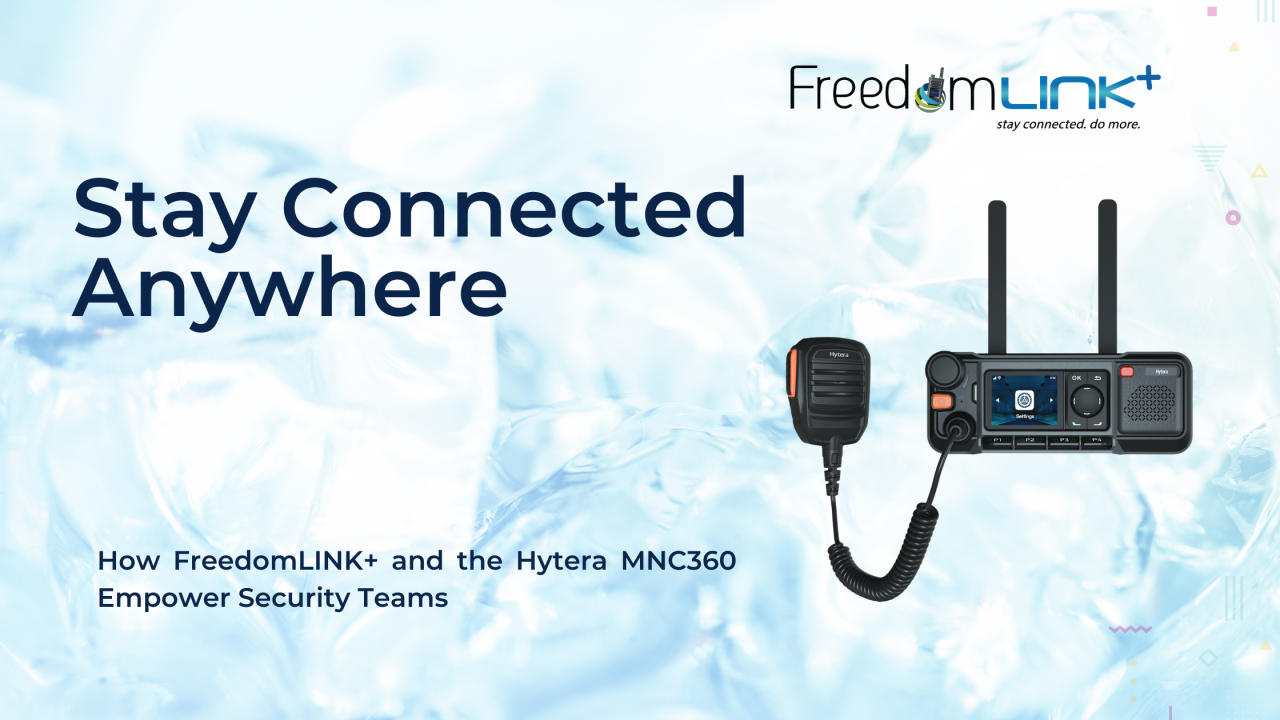
How FreedomLINK+ and the Hytera MNC360 Empower Security Teams

Stay Connected Anywhere: How FreedomLINK+ and the Hytera MNC360 Empower Security Teams

09 December 2025

In the fast-paced world of security services, communication can make the difference between a safe operation and a missed opportunity. Security teams need a solution that provides instant, reliable, and nationwide communication, no matter where the team is deployed. That’s where FreedomLINK+ combined with the Hytera MNC360 comes in.

Nationwide Push-to-Talk Connectivity

FreedomLINK+ is a nationwide push-to-talk (PTT) service that ensures your team stays connected beyond local networks. Whether your security personnel are patrolling a large facility, covering multiple sites, or traveling across cities, FreedomLINK+ provides instant communication without the limitations of traditional radio coverage.

The Power of the Hytera MNC360

The Hytera MNC360 is a rugged, LTE-enabled two-way radio designed for demanding environments. With crystal-clear audio, long battery life, and durable construction, the MNC360 ensures your team can communicate effectively, even in challenging conditions. Its intuitive interface and easy-to-use PTT button mean your team can stay focused on their tasks instead of struggling with complicated devices.

Benefits for Security Companies

Security companies gain significant advantages by combining FreedomLINK+ and the MNC360:

  • Instant Communication: Connect your team in real-time to respond faster to incidents.
  • Nationwide Coverage: Communicate across cities and sites without interruption.
  • Rugged Reliability: Devices built to withstand demanding, outdoor, and high-stress environments.
  • Fleet Management: Streamline team coordination with easy-to-manage devices.

Why It Matters

In security, seconds matter. A reliable communication system allows your team to respond faster, coordinate more efficiently, and operate with confidence. FreedomLINK+ and the Hytera MNC360 provide the technology security companies need to protect their clients and their staff effectively.

Invest in your team’s safety and efficiency with FreedomLINK+ and the Hytera MNC360 — the ultimate communication solution for modern security operations.

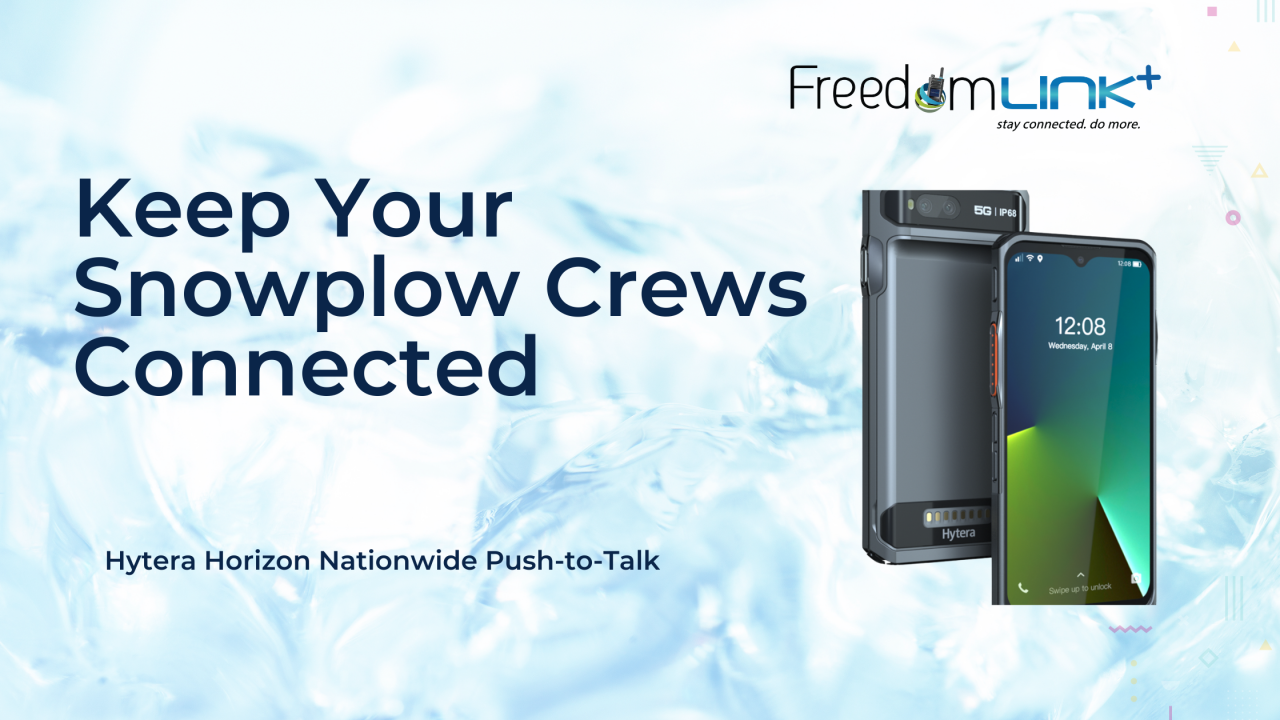
Keep Your Snowplow Crews Connected with Hytera Horizon Nationwide Push-to-Talk

Keep Your Snowplow Crews Connected with Hytera Horizon Nationwide Push-to-Talk

02 December 2025

Winter weather brings unique challenges for snowplow crews. Heavy snow, icy roads, and widespread coverage areas make reliable snowplow communication critical for safety and efficiency. Traditional radios or cell phones often fall short, leaving crews disconnected when they need instant updates the most.

That’s where Hytera Horizon Nationwide Push-to-Talk (PTT) comes in—a solution designed to keep your fleet connected no matter the storm or location.

The Communication Challenge for Snowplow Teams

Snowplow crews operate over large, often remote areas. City streets, rural highways, and suburban neighborhoods can all present signal challenges. Limited-range radios and unreliable cell service can delay important updates, slowing response times and increasing risks to crew safety.

Effective fleet coordination depends on clear, instant communication—especially during winter storms when every second counts.

How Hytera Horizon Improves Snowplow Communication

Hytera Horizon Nationwide PTT provides nationwide coverage and instant communication capabilities, enabling crews to stay in sync across the entire service area.

Key Benefits Include:

  • Nationwide Coverage: Keep every truck connected, from urban streets to rural roads.
  • Instant Group Calls: Communicate with multiple crews simultaneously for faster response.
  • Crystal-Clear Audio: Reliable communication even in harsh weather conditions.
  • Real-Time Fleet Coordination: Track every plow truck and make quick dispatch decisions.
  • Easy Deployment: Works with Hytera radios or mobile devices with minimal setup.

Why Nationwide PTT Matters for Snowplow Operations

Efficient snowplow communication isn’t just about convenience—it directly impacts productivity and safety. With Hytera Horizon, your team can:

  • Clear streets and highways faster
  • Avoid missed or redundant routes
  • Respond quickly to emergencies
  • Keep supervisors updated in real-time

Tips for Optimizing Your Fleet Communication

  1. Equip all crew members with Hytera Horizon-compatible devices.
  2. Create pre-set group channels for rapid coordination.
  3. Regularly test communication systems before major storms.
  4. Use tracking features for real-time fleet monitoring.

Conclusion

Winter operations demand reliable, nationwide push-to-talk communication. Hytera Horizon ensures your snowplow crews remain connected, coordinated, and safe, no matter the storm or location.

Investing in advanced PTT technology is an investment in fleet efficiency, crew safety, and faster snow removal. Don’t let winter weather slow your team down—keep your roads clear and your crews connected with Hytera Horizon.

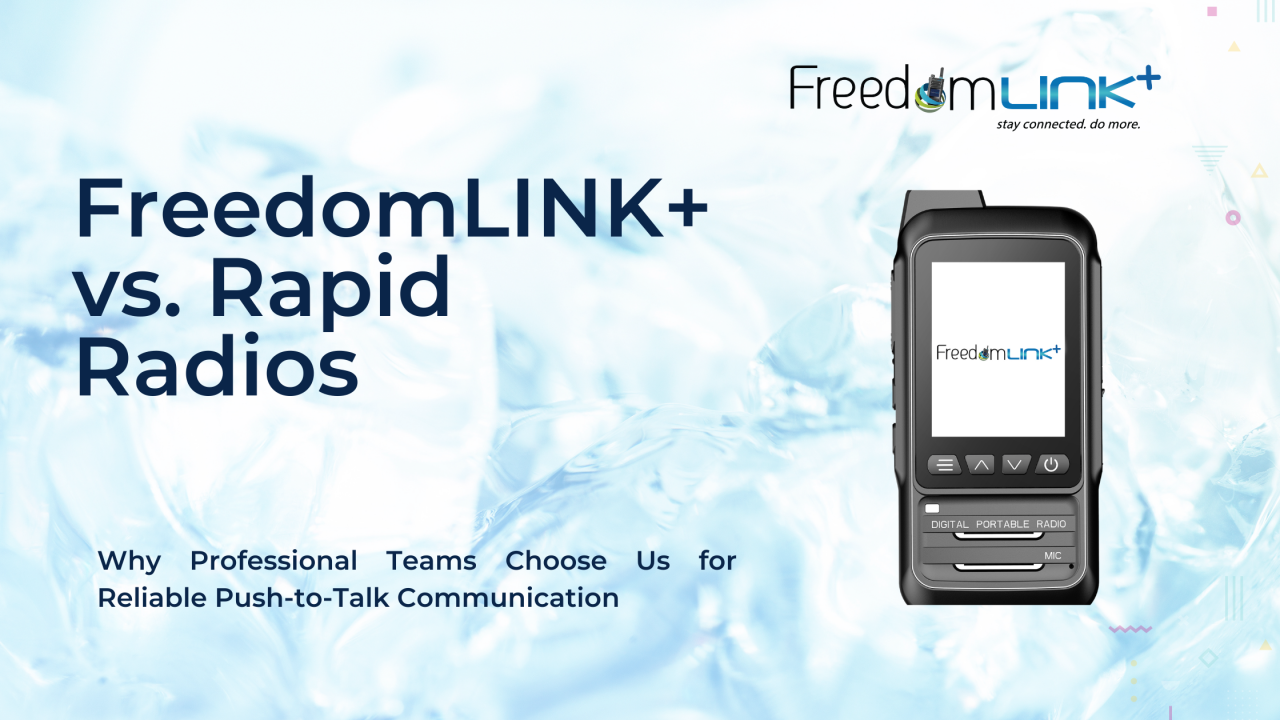
FreedomLINK+ vs. Rapid Radios: Why Professional Teams Choose Us for Reliable Push-to-Talk Communication

FreedomLINK+ vs. Rapid Radios: Why Professional Teams Choose Us for Reliable Push-to-Talk Communication

25 November 2025

FreedomLINK+ Outshines Rapid Radios in Features, Reliability, and Support. 

Discover How Our Nationwide PoC Platform Keeps Your Team Connected, Safe, and Efficient

When it comes to push-to-talk (PTT) communication, Rapid Radios offers a simple, yearly fee option for nationwide use. Their rugged handheld devices provide LTE/WiFi connectivity, encrypted private or group calls, and long battery life. Multi-carrier switching helps avoid signal drops, making them a solid choice for families and hobbyists. Their focus on basic reliability and a one-year warranty appeals to users who want straightforward, low-maintenance communication without monthly fees.

But for professional teams, FreedomLINK+ delivers far more than just basics.

Our platform is built for businesses that rely on seamless communication to keep operations running smoothly. FreedomLINK+ adds advanced tools that improve efficiency, accountability, and team coordination:

  • Live GPS tracking for fleet and team visibility
  • SOS alerts for instant emergency notifications
  • Secure voice with automatic roaming to maintain uninterrupted coverage
  • All-call, group, and private call modes optimized for professional workflows
  • Dispatch console integration for centralized monitoring
  • Transparent annual or monthly airtime costs with no hidden fees
  • Add-ons: Lone Worker, Job Ticketing, Texting, Voice Playback, Indoor GPS, Patrol, Video, Limited Management Platforms

While Rapid Radios provides email-based support with varied response times, FreedomLINK+ is known for friendly, fast, and knowledgeable assistance. From device setup to troubleshooting, our team ensures your operations stay running without costly downtime.

Real-World Scenarios Where FreedomLINK+ Excels

  1. Construction Sites: Keep multiple crews coordinated across large sites with GPS tracking and group call management.
  2. Logistics & Delivery Fleets: Monitor vehicles in real time and instantly communicate changes to routes or schedules.
  3. Facility Management & Maintenance Teams: Quickly dispatch staff to handle urgent repairs, coordinate janitorial or technical teams, and track progress in real time for efficient operations.

Feature & Support Comparison


Rapid Radios

FreedomLINK+

Key Features

Encrypted PTT, multi-carrier switching, no monthly fees, rugged design, long battery life

GPS/SOS tracking, secure voice/roaming, group/all-call/private modes, rugged LTE/WiFi devices, transparent airtime

Coverage

Nationwide unlimited, global available

Nationwide with professional-grade reliability, Other countries available

Integrations

Limited; basic device focus

Dispatch-friendly with team monitoring, Lone Worker, Job Ticketing, Texting, Voice Playback, Indoor GPS, Patrol, Video, Limited Management Platforms

Customer Support

Email-based, mixed reviews on response times

Highly rated for friendly, fast assistance


Bottom Line

  • Rapid Radios: A strong choice for personal users seeking simple, fee-free nationwide communication.
  • FreedomLINK+: The professional upgrade for teams who need enhanced features, operational efficiency, and decades of reliable experience to keep business operations running smoothly.o

Contact us, (715) 832-6763, today to get started with FreedomLINK+ nationwide radios and elevate your team's connectivity.

Note: Competitor information is based on publicly available sources and may change over time.

  1. Limited Coverage With Traditional LMR Radios?
  2. Radio Trends Shaping 2026
  3. The ROI of Upgrading to FreedomLINK+ Nationwide Push-to-Talk for Your Fleet
  4. PoC vs. Traditional Two-Way Radios: What’s the Difference and Which Is Right for You?

Page 1 of 3

  • 1
  • 2
  • 3
freedom link + logo freedom link + logo